
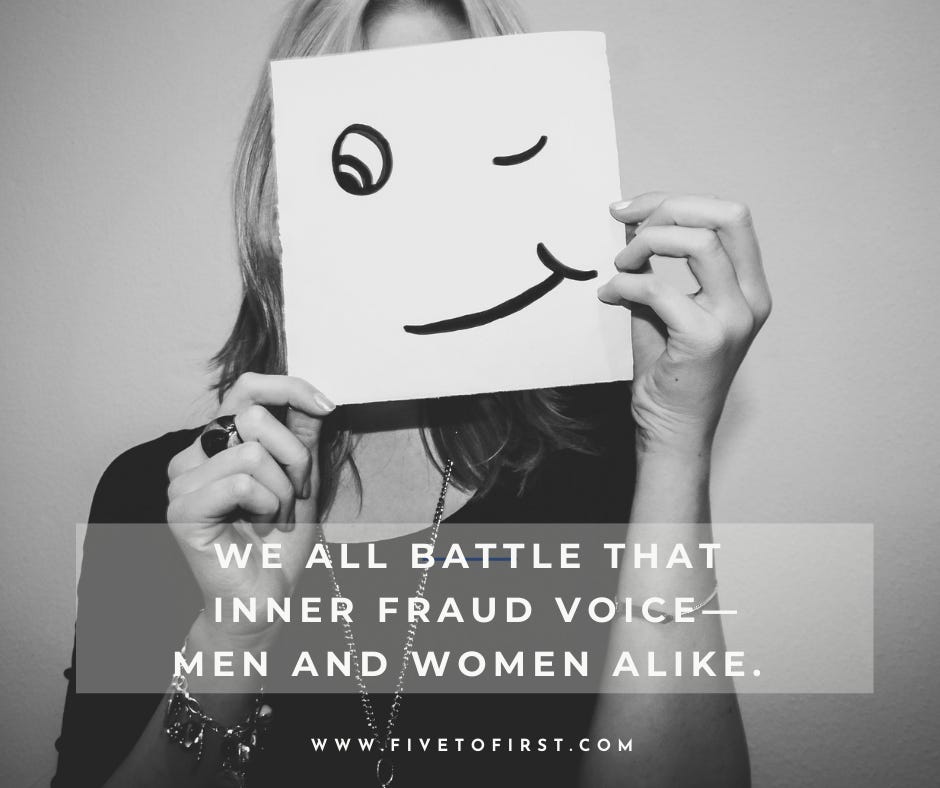
It probably wasn’t until Interview #135 that it hit me: Pretty much all of us struggle with feeling like frauds.
As editor of the long-running Barefoot Writer magazine, I’ve directly probed into the minds of over 160 high-achieving writers so far.
It’s fascinating work. These are writers at the top of their field: best-selling novelists, million-dollar copywriters, digital marketing entrepreneurs, a Tony-winning playwright…
And yet…
Every interview reveals some kind of internal struggle, whether it’s the fear of being “found out,” not having a clue what they’re doing, or the worry they can’t keep up with their success.
You’ve probably heard this jumble of rotten feelings is called imposter syndrome—also known as that nagging sense that anything good you’ve experienced was just dumb luck.
That you don’t really have what it takes and never did.
Most of the time, this is framed as a women’s issue. Because statistically, women report experiencing it more often and more intensely.
But that’s not the whole story.
Men feel it, too. They’re just less likely to voice it. The men I’ve asked directly, who opened up about imposter syndrome, were vulnerable and real. They struggle with additional pressure to fit the strong man/hero mold.
Because heroes don’t face imposter syndrome.
Supposedly.
The thing is, if we leave men out of the conversation, it only deepens the stigma.
So I’d like to talk about why imposter syndrome is so widespread, yet hardly acknowledged or accepted.
Who Gave You Permission?
It was 1978 when psychologists Pauline Clance and Suzanne Imes studied a group of high-achieving women who struggled to take credit for their accomplishments. Clance and Imes identified this as imposter syndrome.
Since then, it’s become a kind of catch-phrase for self-doubt.
And for many who work in the online space, it feels magnified—especially if you find it hard to post pictures on social media that showcase your absolutely amazing life. 🙋🏼♀️
But here’s the thing. While women have historically been studied more in this context, the underlying psychology of it all—that shaky fear of inadequacy, drive toward perfection, and kneejerk comparisons—well, those are universal.
It doesn’t matter if you’re a woman or if you identify as a woman. Doesn’t matter if you’re a man or identify as such. Doesn’t matter if you’re neither of these. In our wide and wonderful world of colorful humans, we’re all at risk of the imposter trap.
There are loads of reasons. One in particular that points to why women feel this so acutely has to do with our upbringings.
From a young age, girls are often praised for being good rather than bold. That propels us into a lifelong habit of seeking approval and doubting our own authority.
And that early conditioning often shows up in subtle ways.
You’re More Than a Good Dog
I experienced this recently on a tour of an Amazon facility. Our group of 20 wore headsets as we walked through the warehouse, partly to shut out the noise of the massive machinery and so we could listen to our tour guide and ask questions.
To ask a question, you pushed a button on your headset. Everybody else could hear the question, but couldn’t necessarily see who asked it because we were constantly moving forward as a big group, eyes focused on the tech-in-progress.
I was fascinated by the place. I asked a lot of questions. Nobody else knew it was me. But I felt a jolt of pleasure every time the tour guide answered, “Such a good question! Here’s why…” I was living the Pavlovian “good-dog” response to a pat on the head.
It was silly. I enjoyed it.

Maybe that explains why I spent so many years struggling to launch my own client-free business. When I finally did, it was because I had a pack of bad-ass women pushing me to do it and effectively telling me my ideas were good and giving me the permission I thought I needed.
But in my case, it’s only because I got to a place where I could be vulnerable about my fears. My besties scooped me right up and told me to quit that shiznet.
The men I’ve interviewed and worked with are wildly accomplished, but many shared similar doubts: Who am I to do this? What if I’m not as good as everyone thinks?
So they feel the same feels, they just don’t often say it out loud. And it’s less likely they’ll have a group of friends to turn to where they can be vulnerable and get support.
A Human Issue at the Core
There’s loads more to be said about imposter syndrome and confidence issues. But I think the first step in helping people through them is making this a human problem, not a woman problem.
The next step is to flip the negative conversation about self-doubt. It’s not all bad, you see. Self-doubt usually goes hand-in-hand with growth. Think of it as protection: your brain naturally resists any step outside your comfort zone, but that’s for your own safety. The subsequent swim to the other side of self-doubt is all about proving to your brain that you can expand. You’ve got this.
So I encourage you to talk more about your imposter thoughts. Normalize them. Also listen for it from others, with zero judgment. Leaders are strongest when they model their own insecurities and show how they got to the other side.
Where Do We Go From Here?
I don’t think we can eliminate imposter syndrome entirely. At least not as humans with evolved social wiring that links social acceptance to survival.
But we can acknowledge it. We can welcome it into the conversation and make it one that welcomes all.
And then we can keep moving forward.
What about you? Where has imposter syndrome shown up in your life?
I get this. I suffer from it once in a while, though I mostly keep a clean and clear mindset with my work. The longer it takes for turnarounds to submissions, or if a slew of rejections come, then it can trigger that imposter syndrome inside me, particularly seeing one writer after another I know or am familiar with get picked up. Or being in the presence of others who are doing well overall. Slow online sales, California nos to internet marketing and chirping crickets at social media can also trigger this feeling. However, I get into a book fair tailored to what I do, I have been able to engage, promote and sell better, I'm having a slow escalation of success and my networking has been tremendous, so I feel things are on the ups. Patience, as ever, is the big thing, even when it feels like driving on a donut in the slow lane and everyone else whisking by.